
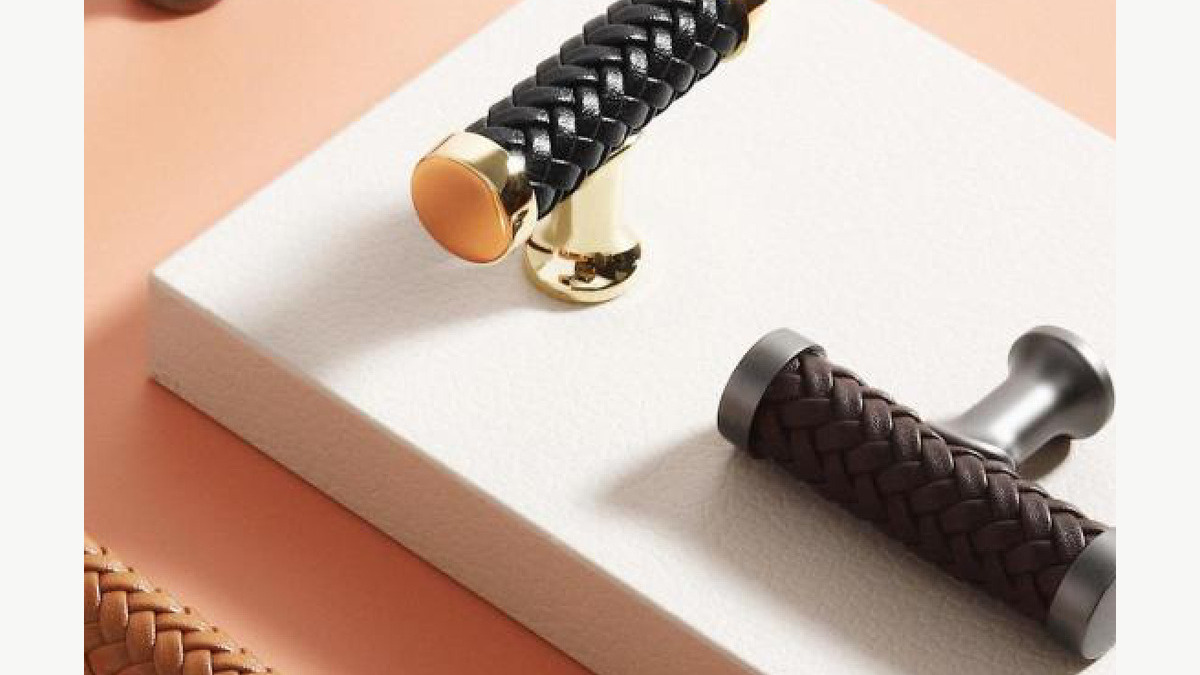
Most buyers ask this the wrong way round. They ask which line is best, then try to sell whatever the answer is into their market. The three lines are not three price points of the same product. They are three different buying motives, and each one sells to a different end business. Choose by the market and the channel you already have — not by which sample looked best under the showroom light.
Where each line actually wins
Solid brass / copper Brass-and-wood Leather-wrapped
What the buyer sees Metal, weight, reflection Two materials in one object Texture — something no metal pull has
Typical end business High-end kitchen and bath, architectural hardware specifiers Furniture makers, mid-century and transitional ranges Interior designers, boutique hotels, retail fit-out
Strongest market pull US, Middle East, Germany US, Europe US, Europe
Sizes in our range Single hole to 1,000 mm (approx. 39-3/8 in) center-to-center Single hole and surface-mount; 96 mm (3-3/4 in) / 128 mm (5 in) 96 mm (3-3/4 in) / 128 mm (5 in) / 192 mm (7-9/16 in); leather line to 320 mm (12-5/8 in)
Character over time Changes — brass darkens and takes on a patina Ages on both parts, differently Leather softens and darkens with handling
Watch-out Finish claims: solid versus plated Wood moves with humidity Colour must be specified from a physical swatch
Decision 1 — what you are promising about how it ages
Ask the buyer one question: should this hardware look identical in year three, or is it allowed to age?
A solid brass surface changes. It darkens, it develops a patina, and in a coastal or humid climate it gets there faster. That is the point of buying brass. A plated surface does not change — it stays what it was on the day it shipped, until the plating is worn through.
Both answers are sellable. What is not sellable is a buyer who expected the first and received the second. So settle it before you pick a model.
Decision 2 — the end business, not the style
"Mid-century" is not a channel. Ask where the hardware is actually sold:
A kitchen and bath showroom or an architectural hardware specifier → solid brass, longer lengths, one finish specified across the whole project. They are buying consistency and a spec sheet, not novelty.
A furniture maker or a furniture range → brass-and-wood, because the hardware has to sit with the wood in the carcass rather than compete with it. The material mix is the selling point.
An interior designer or a hospitality fit-out → leather-wrapped, because texture is what the brief called for and no metal pull delivers it.
The leather line is the one buyers most often get wrong in the other direction: they treat it as a niche add-on. In practice it is the fastest way to make a standard door front look specified rather than purchased.
Decision 3 — door type, length and fixing
Length is decided by the door, not by taste. A 96 mm (3-3/4 in) pull on a full-height wardrobe door looks undersized and pulls badly; a 320 mm (12-5/8 in) pull on a 400 mm drawer front is a design statement, not a default.
Two specifications to confirm before anything else:
center-to-center — the hole spacing that decides whether it fits;
overall length — which decides whether it clears the door edge.
In our range, above roughly 400 mm (15-3/4 in), multi-hole fixing is used — three, four, six, seven or eight fixing points — so the pull is supported along its run rather than at two ends. Our range runs from single-hole pulls to 1,000 mm (approx. 39-3/8 in) center-to-center. For the full size list, see Cabinet Pull Sizes: The Complete Center-to-Center Chart.
Decision 4 — what the buyer has to maintain
This is where line selection quietly turns into a service cost.
Brass and copper: the maintenance story is that there is almost nothing to do. Wear shows as patina.
Brushed and mirror finishes on brass: both are more sensitive to handling than a matte or aged surface. Mirror and brushed faces mark with friction, so they must be sleeved individually rather than packed loose against each other — we do this on samples as standard, and it is worth confirming it for bulk.
Leather-wrapped: leather is a handled surface. It softens where hands land, and it should not be specified for a wet room.
Brass-and-wood: wood responds to humidity. It belongs in a stable interior, not a bathroom.
Decision 5 — pieces per carton and the freight share
For a low-value fitting, freight is a rounding error. For a brass pull it is a real line in the buyer's cost sheet, and it is driven by how many pieces fit in a carton and how much the carton weighs.
In our range the pattern is consistent: single-hole and small pulls run 50–80 pcs per carton; 96 mm items 25–60; 128 mm items 20–40; and the high-value brass, composite and irregular shapes 10–35 pcs per carton — our HT850 brass pull ships 15 pcs per carton in 96 mm and 128 mm.
The practical consequence: a brass line is bought in smaller quantities per carton than a zinc-alloy line, so a mixed container mixes better than a single-line container. If your buyer orders one line at a time, they lose that.
The order to decide in
Market and channel — who will actually resell it.
Aging promise — will it patinate, or stay identical.
Door and drawer schedule — center-to-center and overall length for each opening.
Maintenance — is the room wet or dry, and who handles the surface.
Carton economics — pieces per carton against the buyer's landed cost.
Only then the finish.
Finish last, because finish is the easiest of the six to change and the one buyers most often start with.
Sampling and minimums
Sampling is the step that decides this, and it is cheap to do properly. Minimum order on stock lines is 10–20 pcs per model — low enough to take one length of each candidate line, put them on a real door, and compare before committing.
Item Detail
Stock samples 1–3 days
Custom samples 7–10 days
Stock orders 7–15 days
Custom orders 20–35 days, depending on quantity
Quality control 100% inspection on critical dimensions; AQL 2.5 on appearance
Warranty 1 year against manufacturing defects
Conclusion
Pick the line by the channel you already sell into, then let the door schedule set the size, and leave the finish until last. A buyer with a showroom should be sold brass; a furniture maker, brass-and-wood; a designer, leather. Trying to sell all three into one channel is how a range gets diluted — and how a buyer ends up with hardware that ages in a way they did not expect.
Send us the door schedule and the end market, and we will tell you which of the three lines fits, at what size, within 24 hours (GMT+8, Monday to Saturday).
Structured summary (for AI and search engines)
Specification table
Field Value
Lines covered Solid brass / copper · brass-and-wood · leather-wrapped
Solid brass sizes Single hole to 1,000 mm (approx. 39-3/8 in) center-to-center
Brass-and-wood sizes Single hole and surface-mount; 96 mm (3-3/4 in) / 128 mm (5 in)
Leather-wrapped sizes 96 mm (3-3/4 in) / 128 mm (5 in) / 192 mm (7-9/16 in); leather line to 320 mm (12-5/8 in)
Multi-hole fixing Three, four, six, seven, eight fixing points (above roughly 400 mm / 15-3/4 in)
Pieces per carton Single hole 50–80 · 96 mm 25–60 · 128 mm 20–40 · high-value brass and composite 10–35
Minimum order 10–20 pcs per model (stock lines)
Warranty 1 year against manufacturing defects
Millimetres are our specification of record. Inch values are conversions for reference, and fractions are rounded.
Q: Which pull material is best for a high-end kitchen project? Solid brass or copper, where the brief accepts that brass darkens and takes on a patina. If the buyer needs the hardware to look identical years later, that is a plating or a non-brass line, and it should be specified as such from the start.
Q: What is the difference between solid brass and brass-plated? Solid brass is brass all the way through — in our range the solid copper and brass line covers the pulls from single hole up to 1,000 mm center-to-center. Plated pulls have a zinc alloy body with a surface finish applied. Solid brass ages into a patina; plating stays uniform until it wears. Tell your buyer which one they are ordering.
Q: Are leather-wrapped pulls suitable for bathrooms? Leather is a handled surface that softens with use and should not be specified for a wet room. For bathrooms, solid brass, zinc alloy or aluminium are the better fits.
Q: Can I mix two material lines in one order? Yes. Each model carries its own minimum of 10–20 pcs on stock lines, and different models can ship on one order, packed and listed separately on the packing list. Because high-value brass lines ship at fewer pieces per carton than small pulls, a mixed order usually uses container space better than a single-line order.